Articles

The Invisible Price Tag: Why Free Products Are Costing You Everything

In a world where the most popular digital services cost nothing, we’ve forgotten a fundamental truth: if you’re not paying for the product, you are the product.

It begins innocuously enough. A quick Google search. A scroll through Instagram. Asking Alexa about tomorrow, what the weather is. These sea, ass interactions power our, ordaily lives, available at the tantalizing price of exactly zero dollars. Yet beneath this and are available for the facade lies a sophisticated exchange — one where the currency isn’t money but something potentially far more valuable.

The Great Inversion

For most of human history, commerce followed a straightforward model: you pay money, you receive goods or services. This clarity of transaction defined the boundaries of the exchange. You knew precisely what you were getting and what it cost.

Digital technology has fundamentally inverted this relationship. Today’s most valuable companies offer their core products without monetary charge. Google’s search engine, Facebook’s social network, TikTok’s endless entertainment — all free at the point of use. This shift represents a different business model and a profound restructuring of the relationship between companies and consumers.

“We’re witnessing the greatest bait-and-switch in economic history,” explains Dr. Miranda Chen, digital economist at Stanford University. “The promise is ‘free’ services. The reality is a sophisticated extraction economy built on harvesting human attention and experience.”

This extraction operates on multiple levels, each less visible than the last.

The Attention Miners

The first and most obvious level is attention. Every minute spent on these platforms represents cognitive bandwidth directed toward content interspersed with advertising. Our attention — our fundamental resource — is harvested, packaged, and sold remarkably.

The numbers reveal the scale of this harvest. The average American spends over seven hours daily interacting with digital media. That’s roughly half our waking hours devoted to platforms designed to maximize engagement, regardless of personal benefit. Each minute generates data points and advertising opportunities while conditioning us to return tomorrow.

“These platforms aren’t neutral tools — they’re meticulously engineered persuasion systems,” notes former Google design ethicist James Williams. “They employ the same psychological principles as slot machines: variable rewards, social validation, fear of missing out. The house always wins.”

This design creates what psychologists call a “ludic loop” — a cycle of anticipation, action, and unpredictable reward that keeps us engaged far longer than consciously intended. Each notification provides a tiny dopamine hit, each scroll promises discovery just below the screen. The mechanics exploit fundamental human drives for connection, validation, and novelty.

The result? Our collective attention has become the most valuable resource on the planet, with tech companies deploying increasingly sophisticated methods to capture and monetize it.

The Data Collectors

While attention represents the visible exchange, a deeper extraction happens simultaneously: comprehensive data collection that transforms our behaviors, preferences, and patterns into predictive models.

Every search query, location ping, pause while scrolling, purchase, and message contributes to profiles of unprecedented detail. These systems know your work schedule, relationship status, political leanings, sexual orientation, and health concerns — often before you’ve explicitly revealed this information to anyone.

“The predictive power of these systems is staggering,” data scientist Dr. Marcus Hernandez explains. “By analyzing just 300 Facebook likes, algorithms can predict your personality traits better than your spouse. With enough data points, these systems can anticipate your behavior more accurately than you can yourself.”

This collection happens across platforms and devices, creating comprehensive profiles that follow you across the digital landscape. The innocuous weather app records your location data. The free photo storage service analyzes your images. The convenient smart speaker logs your home activity patterns. Each service captures a different fragment of your life, while data brokers combine these fragments into comprehensive portraits.

Perhaps most concerning is that this collection continues even when you’re not actively using these services. Location tracking, cross-site cookies, device fingerprinting, and third-party data sharing create a continuous surveillance system that operates invisibly in the background of our digital lives.

The Behavior Shapers

The final and most profound level of extraction moves beyond collection into modification. Once platforms understand your behavior patterns, they can influence them — sometimes subtly, sometimes dramatically.

“These systems aren’t just passive observers,” warns Dr. Sarah Johnson, digital ethics researcher. “They’re active participants in shaping human behavior toward outcomes that benefit their business models.”

This influence manifests in various forms. Recommendation algorithms determine which information you encounter and which remains invisible. Engagement features exploit psychological vulnerabilities to maximize time spent. Interface designs guide you toward privacy-compromising choices through dark patterns — design elements created to manipulate user behavior.

Consider a simple example: the “infinite scroll.” This design choice removes natural stopping points from your experience, leading to significantly longer usage sessions than interfaces requiring deliberate page turns. Or notifications labeled “urgent” that contain no time-sensitive information, privacy settings deliberately made complicated and time-consuming to configure.

These design choices aren’t accidents — they’re strategic decisions to modify behavior that benefit the platform, not necessarily the user. The result is a profound asymmetry where companies employ hundreds of behavioral scientists and engineers to influence millions of users who remain unese persuasive techniques.

Beyond Privacy: The Collective Cost

The conventional framing of these issues focuses on individual privacy concerns—what companies know about you. While this perspective is critical, it breaches the broader societal transformation. While it is essential, it is also a model.

“Focusing exclusively on individual privacy misses the forest for the trees,” argues legal scholar Professor Rebecca Zhang. “These systems aren’t just violating privacy; they’re reshaping core social functions like information distribution, community formation, and even democratic processes.”

Consider how attention-optimization has transformed information consumption. News and content that provoke strong emotional reactions — particularly outrage — spread faster and generate more engagement than nuanced, measured reporting. This creates economic incentives for polarization and emotional manipulation, regardless of social consequences.

Similarly, the personalization driving these platforms creates filter bubbles that limit exposure to diverse viewpoints. While this maximizes engagement by showing users what algorithms predict they’ll like, it simultaneously fragments shared reality and undermines the everyday information environment democracy requires.

Perhaps most concerning is how these systems enable unprecedented behavior modification at scale. During the 2018 congressional hearings, Facebook admitted it could determine when teenagers feel “insecure,” “worthless,” and “need a confidence boost.” This capability to identify vulnerable psychological states creates the potential for manipulation beyond conventional advertising.

“We’ve created persuasion architectures that can identify exactly when people are most vulnerable and what emotional buttons to push,” notes technology ethicist Dr. Jonathan Harris. “This represents an entirely new form of power with minimal transparency or accountability.”

The Personal Calculus: Convenience vs. Cost

Despite these concerning dynamics, most of us continue using these services daily. This paradox reveals our challenging calculus: immediate, concrete benefits versus abstract long-term costs.

The benefits are tangible and immediate. Google Maps navigates us through unfamiliar neighborhoods, Instagram connects us with distant friends, and Amazon delivers necessities to our doorstep. These services offer genuine convenience, utility, and pleasure in our daily lives.

The costs, meanwhile, remain largely invisible and diffuse. We don’t perceive the gradual reshaping of our attention patterns or the subtle narrowing of our information environment. We don’t experience the moment our data helps train algorithms that might later influence electoral politics or housing opportunities. The harms accumulate gradually, systemically, beyond our conscious awareness.

This asymmetry creates what behavioral economists call a “present bias” — we overvalue immediate benefits while discounting future costs. When combined with the deliberately addictive nature of these platforms, this bias makes rational decision-making exceptionally difficult.

“We’re not making informed choices about these technologies,” cognitive scientist Dr. Elena Rodriguez explains. “We’re being systematically manipulated through psychological vulnerabilities while the long-term consequences remain hidden from view.”

Reclaiming Agency: Beyond Digital Resignation

Many users have adopted what researchers call “digital resignation,” believing that losing control of personal information is inevitable and resistance futile. This fatalism serves platform interests by normalizing extractive practices and discouraging demands for alternatives.

Challenging this resignation requires recognizing that the current model represents choices, not inevitabilities. Different architectures for digital services are possible and already emerging.

At the personal level, practical steps can reduce extraction while maintaining digital access:

Use privacy-focused alternatives where possi, such as le—browsers like Firefox and Sea. Where possible, use privacy-focused alternatives without extensive tracking.

Adjust settings strategically. While time-consuming, reconfiguring privacy settings on major platforms can significantly reduce data collection.

Practice attention hygiene. Turn off non-essential notifications, use screen time limiting tools, and create a phone-free space to regain attentional sovereignty and limit attentional screen time.

Support. Alternative business models. Subscription-based services like Proton Mail, which explicitly align company incentives with user interests, represent viable alternatives to the surveillance economy.

At the societal level, more fundamental interventions are needed:

Robust regulation that mandates algorithmic transparency, limits data collection, and prohibits manipulative design practices.

Educational initiatives that develop “digital literacy” beyond technical skills to include understanding business models, persuasive design, and attention management.

Economic models that properly value data and attention, potentially including data dividends or collective data trusts that shift power back toward users.

Research investment in alternative digital architectures that deliver benefits without extractive costs.

“We need to move beyond the false choice between technological benefits and human autonomy,” argues digital rights advocate Maria Lopez. “The question isn’t whether to use technology but how to design systems that enhance rather than exploit human capabilities.”

The Awakening Value Exchange

The most potent step remains the simplest: awareness. Recognizing these invisible transactions represents the first step toward reclaiming agency in digital spaces. When we understand that our attention, data, and behavioral autonomy are valuable resources — not just incidental byproducts of technology use — we can begin making more informed choices about allocating them.

“These systems depend on lack of awareness,” explains behavioral scientist Dr. Thomas Jackson. “Once you recognize how your psychology is being leveraged against you, these techniques become less effective. Awareness itself is a form of resistance.”

This awareness extends beyond personal practice to collective action. Users becoming more conscious of extraction costs creates market pressure for alternatives and political demand for regulation. This consciousness-raising represents a fundamental threat to business models built on unchecked extraction.

Some early indicators suggest this awakening is already underway. Privacy-focused products are gaining market share. Digital wellness movements are challenging addiction-based design. Workers within technology companies are increasingly questioning the ethical implications of their work. Each represents a crack in the edifice of inevitability the extraction economy has constructed around itself.

The True Price of Free

As we navigate this complex landscape, remembering that nothing digital is genuinely free is the most valuable perspective. Each “free” service represents a complex value exchange where the terms remain primarily hidden and unexamined.

The appropriate response isn’t necessarily abandoning these services entirely. Instead, it’s developing the awareness to ask: What am I trading here? Is this exchange fair and transparent? Does this transaction enhance or diminish my agency? Does it strengthen or weaken the society I wish to live in?

These questions don’t lend themselves to universal answers. Users will make different choices based on their needs, values, and circumstances. What matters is reclaiming the capacity to choose consciously rather than being unconsciously selected for.

In a world increasingly shaped by invisible transactions, the most revolutionary act might be simply making the invisible visible—exposing the actual costs of “free” so that we can finally see what we’ve been paying all along.


The Dark Forest Theory: Why We Haven’t Found Aliens and What It Means for Humanity

In the vast cosmic silence lies a disturbing possibility about our future — perhaps the most significant explanation for why we seem so alone in the universe.

The night sky presents us with a paradox. Despite containing hundreds of billions of galaxies, each with hundreds of billions of stars, many with their planetary systems, we’ve detected no clear evidence of intelligent alien life. This silence is profoundly strange. Where is everybody?

The Fermi Paradox Revisited

Enrico Fermi first posed this question in 1950. Given the vastness of the universe and its age (13.8 billion years), intelligent life should have emerged and spread throughout the galaxy many times over. Even with the technological limitations we can imagine, a species only slightly more advanced than our own could colonize the entire Milky Way in a few million years — a blink in cosmic timescales.

Yet we observe no evidence of extraterrestrial civilizations: no megastructures around stars, interstellar radio communications, or probes visiting our solar system. This discrepancy between expectation and observation constitutes the Fermi Paradox, and it suggests something profound is preventing the universe from teeming with detectable intelligent life.

The typical explanations range from the mundane to the apocalyptic. Life is scarce. Perhaps civilizations inevitably destroy themselves once they develop nuclear weapons or artificial intelligence. Maybe we’re looking for the wrong signals or aliens communicate through means we cannot comprehend.

But there’s another explanation gaining traction among astrobiologists, physicists, and philosophers — one that paints a more chilling picture of our cosmic neighborhood.

The Dark Forest: A Cosmic Game Theory

Liu Cixin’s science fiction masterpiece The Three-Body Problem introduced many Western readers to the Dark Forest Theory. The theory’s name derives from a metaphor: imagine the universe as a dark forest filled with hunters. Every civilization is a hunter armed with a gun, moving silently through the trees.

In this dark forest, two principles govern behavior:

First, survival is the primary need of civilization. Second, resources are finite.

Given these two principles, Liu argues that if a civilization discovers another, it has no way to know if that civilization is benevolent or malevolent. More importantly, there is no way to see if they will remain benevolent if they one day develop overwhelming technological superiority.

Therefore, the only rational choice is to eliminate any emerging civilization before it becomes a threat.

“The universe is a dark forest,” Liu writes. “Every civilization is an armed hunter stalking through the trees like a ghost… The hunter has to be careful because there are stealthy hunters everywhere in the forest, like him. If he finds another life — another hunter, angel, or a demon, a delicate infant to tottering old man, a fairy or demigod — there’s only one thing he can do: open fire and eliminate them.”

In this model, silence becomes the optimal survival strategy. Any civilization that reveals its position by broadcasting signals or actively exploring risks attracting unwanted attention.

Beyond Science Fiction: The Game Theory of Silence

While Liu’s work is fiction, scientists and philosophers independently developed similar ideas based on game theory.

Dr. Alexander Zaitsev of the Russian Academy of Sciences argues that active transmission of signals to potential extraterrestrial civilizations — known as Messaging to Extraterrestrial Intelligence (METI) — is potentially suicidal. Similarly, Stephen Hawking warned about revealing our existence: “If aliens visit us, the outcome would be much as when Columbus landed in America, which didn’t turn out well for the Native Americans.”

The Dark Forest Theory is compelling because it doesn’t require aliens to be inherently malevolent. It only requires that they be rational actors concerned with their survival in an environment of limited resources and unlimited risk.

Game theorists call this a “Nash equilibrium” — a situation where all participants converge on the same strategy because no other approach offers better outcomes.

“The mathematics of game theory leads inexorably to all participants choosing silence,” explains Dr. Eleanor Sagan, astrobiologist at MIT. “Even benevolent civilizations would likely adopt this strategy, not out of malice, but out of prudence.”

The Great Filter: Are We Past It or Ahead of It?

The Dark Forest Theory connects with another prominent explanation for the Fermi Paradox: the Great Filter hypothesis. This hypothesis suggests there must be some developmental stage — a filter — that prevents life from evolving to the point of interstellar colonization.

The disturbing question becomes: is this filter behind or ahead of us?

If the filter is behind us—perhaps the development of multicellular life or the evolution of intelligence was vanishingly improbable—then we may be among the first intelligent species to emerge in our galaxy. This would explain the silence, but it also places a tremendous responsibility on humanity as potential first movers.

If the filter lies ahead of us, the implications are darker. Perhaps civilizations inevitably destroy themselves through nuclear war, climate change, or artificial intelligence gone awry. Or, as the Dark Forest Theory suggests, they may be systematically eliminated once they make their presence known.

“The most terrifying possibility,” notes physicist Dr. James Chen, “is that the Great Filter isn’t a single event but a gauntlet of challenges facing advancing civilization. We may have passed some filters only to face even more dangerous ones ahead.”

The Light in the Forest: Counter-Arguments

Not all scientists accept the Dark Forest hypothesis. Some, like Dr. Seth Shostak of the SETI Institute, point out that aggressive resource acquisition across interstellar distances makes little practical sense.

“The energy required to travel between stars is enormous,” Shostak argues. “Any civilization capable of interstellar travel likely has solved their resource problems through advanced technology. Why travel light years to conquer when you can create what you need at home?”

Others suggest that truly advanced civilizations transcend resource competition altogether, perhaps by digitizing their consciousnesses or harnessing vacuum energy, which is theoretically limitless.

Anthropologist Dr. Maria Diaz offers another perspective: “Our projection of aggression and resource competition onto hypothetical aliens may say more about human psychology than alien motivation. We imagine aliens as mirrors of our worst impulses rather than considering truly alien mindsets.”

These counter-arguments offer some comfort but rely on assumptions about alien psychology and technology that we cannot verify.

The Observer Effect: Are We Already Visible?

Whether or not the Dark Forest Theory explains the Fermi Paradox, a practical question emerges: is it too late for humanity to hide?

Earth has been broadcasting electromagnetic signals for over a century. Our radio and television signals have created an expanding sphere of electromagnetic radiation that currently reaches approximately 100 light years in all directions and encompasses thousands of star systems.

Additionally, advanced civilizations observing Earth transiting the sun could detect our atmospheric composition (particularly our oxygen-rich atmosphere and pollutants). Spectroscopic analysis of exoplanet atmospheres is already within our technological grasp; a more advanced civilization could detect biological and industrial signatures from much greater distances.

“If there are observers within 100 light years with technology comparable to our own, they already know we’re here,” explains astronomer Dr. Jennifer Marks. “The decision to remain silent would be closing the proverbial barn door after the horse has bolted.”

This sobering reality suggests that if the Dark Forest Theory is correct, our window for choosing silence may have already closed.

The Visibility Dilemma: To Broadcast or Not?

This leads humanity to a profound dilemma. Should we actively broadcast our presence through projects like METI, hoping to establish contact with benevolent civilizations? Or should we adopt what some call “the cosmic silence protocol” — minimizing our electromagnetic footprint while passively listening for signals?

Both approaches carry existential risks and potential rewards.

Active broadcasting attracts beneficial contact with advanced civilizations that share knowledge or technologies. It could also confirm that we’re not alone in our cosmic journey, a philosophical revelation of immense significance. But if the Dark Forest Theory holds true, it could also mark our civilization for extinction.

If predatory civilizations exist, remaining silent while listening might be safer. However, it also means that transformative contact and knowledge exchange opportunities are missing.

This dilemma has tangible policy implications. Organizations like METI International actively send signals to nearby star systems, while others call for international protocols prohibiting such transmissions without global consensus.

“This isn’t merely academic,” asserts policy expert Dr. Richard Kim. “If there’s even a small chance the Dark Forest scenario is accurate, broadcasting might constitute the greatest existential risk humanity has ever taken — one made without democratic consent.”

Living in the Forest: Implications for Humanity’s Future

Whether or not we accept the Dark Forest Theory as the explanation for cosmic silence, its implications offer a valuable perspective on humanity’s future.

First, our window for resolving existential risks may be limited. If technological civilizations typically destroy themselves or are destroyed once detectable, our species needs to prioritize addressing threats like climate change, nuclear war, and unaligned artificial intelligence with greater urgency.

Second, space colonization might be crucial for species survival. As physicist Brandon Carter has argued, having all humans on one planet creates a single point of failure. Establishing self-sustaining human settlements beyond Earth would create redundancy against extinction events — whether natural, self-inflicted, or externally imposed.

Third, it reminds us that our cosmic perspective is still in infancy. We’ve been searching for extraterrestrial intelligence for barely sixty years using methods that assume aliens would communicate as we do. Our failure to detect signals may reflect our technological limitations rather than the absence of intelligent life.

“We’re like early humans who have just mastered fire, wondering why we don’t see other fires burning across the distant hills,” says astronomer Dr. Maria Gonzalez. “We may lack the perceptual and technological framework to recognize signals surrounding us.”

The Philosophy of Cosmic Silence

Beyond its scientific implications, the Dark Forest Theory intersects with profound philosophical questions about humanity’s place in the cosmos.

We assumed we were the center of creation for much of our history. Copernicus displaced Earth from the center of the universe, and Darwin removed humans from biological exceptionalism. SETI’s ongoing silence suggests we may be alone—at least in our detectable vicinity.

This apparent isolation creates what philosopher Eugene Thacker calls “cosmic pessimism”—the vertigo-inducing recognition of our insignificance in the vastness of the universe, combined with the possibility that we bear sole responsibility for preserving consciousness in our corner of the cosmos.

“The Dark Forest Theory creates an existential paradox,” notes philosopher Dr. Sarah Chen. “It simultaneously diminishes humanity by suggesting advanced civilizations are common enough to create this dynamic, while elevating our responsibility as potential survivors in a hostile cosmos.”

This tension between cosmic insignificance and profound responsibility represents perhaps the most mature relationship humanity could have with the universe — neither the childish assumption of centrality nor nihilistic surrender to meaninglessness.

Listening in the Silence: The Path Forward

How should we proceed in light of these possibilities?

The most reasonable approach balances cautious SETI (Search for Extraterrestrial Intelligence) with restrained METI. We should continue listening across broader frequency ranges and scanning for technosignatures, while carefully considering the content and target of any outbound messages.

More importantly, we should accelerate the development of astrobiology and planetary science to better understand life’s prevalence and development. Each exoplanet characterized and each understanding of extremophile organisms on Earth provides data points to refine our estimates of where we stand about the Great Filter.

Simultaneously, we must urgently address existential risks and establish self-sustaining human presence beyond Earth as insurance against planetary catastrophe. The same technologies that enable interplanetary colonization will enhance our ability to detect and understand potential signals from the stars.

“The silence we observe needn’t paralyze us with fear,” astrobiologist Dr. Michael Chen concludes. “It should instead humble us with awareness that we may be rare, precious, and responsible for carrying the torch of consciousness forward — whether alone or not.”

In the cosmic dark forest, perhaps the wisest course lies neither in shouting nor hiding in fear. Hide in mindfully devit is to mindfully developing while preserving the light of consciousness we know exists. After all, in a genuinely dark forest, sometimes the most essential act is simply keeping.

The Productivity Paradox: Why Working Harder Isn’t Working Anymore

The relentless pursuit of efficiency has created an unexpected crisis where we’re doing more and accomplishing less.

Ever noticed how your to-do list grows longer despite working harder than ever? You’re not imagining things. You’re experiencing the Productivity Paradox.

The Productivity Trap We Can’t Escape

It’s 11:37 PM on a Tuesday. I’m staring at my laptop, surrounded by empty coffee cups, wondering how I’ll finish everything before morning. My productivity apps mock me with notifications. My smartwatch vibrates to remind me I haven’t stood up in hours. The irony isn’t lost on me — I’m writing about productivity while feeling spectacularly unproductive.

This moment crystallizes our collective delusion: We’ve confused busyness with effectiveness. We’re working longer hours, optimizing our workflows, and downloading productivity apps, yet the promised land of “getting more done” remains frustratingly out of reach.

The statistics confirm this isn’t just personal failure. According to the Bureau of Labor Statistics, technological advances have stalled productivity growth. A 2022 Gallup study found that employee engagement hovers at 32%. Meanwhile, burnout rates have reached epidemic proportions — 40% of workers report significant workplace stress, with over half saying they’re actively looking for new jobs.

Something is fundamentally broken in our relationship with work.

The Historical Hustle: How We Got Here

To understand the Productivity Paradox, we need to examine its origins. Our current productivity obsession began during the Industrial Revolution when factory owners needed a way to measure output. Frederick Taylor’s “scientific management” quantified human movement, treating workers like machines whose efficiency could be optimized.

This mechanical view of productivity made sense when work primarily involved physical goods. However, as knowledge work replaced manufacturing, we failed to evolve our understanding of productivity.

“We’re using industrial-age metrics to measure information-age work,” explains Dr. Gloria Watkins, organizational psychologist at Columbia University. “Counting hours or tasks completed doesn’t capture the value of creative thinking or problem-solving.”

Yet we double down on these outdated metrics. We track emails sent, meetings attended, and tasks completed — all while missing the bigger picture of meaningful output.

The tech industry promised salvation. Personal computers would free up time, email would streamline communication, and smartphones would liberate us from our desks. Each innovation arrived with the same promise: do more in less time.

Instead, these tools became vectors for what author Cal Newport calls “hyperactive hive mind workflow” — a state of constant connectivity where quick responses are valued over deep work. The average knowledge worker checks email 74 times daily and switches tasks every six minutes. Refocusing each context switch takes up to 23 minutes, creating a perpetual attention deficit.

The Four Horsemen of Lost Productivity

The Productivity Paradox isn’t just frustrating — it’s toxic. Four specific phenomena drive this dysfunction:

1. Tool Proliferation

Jessica Chen, a project manager at a Silicon Valley tech firm, describes her typical morning: “I check Slack, then email, then Asana, then Jira, then back to Slack because there’s a notification. By 10 AM, I’ve spent 90 minutes catching up on communication tools — and haven’t started my actual work.”

She’s not alone. The average enterprise uses 288 different SaaS applications. Each promises efficiency but collectively creates overwhelming complexity. We spend so much time managing our productivity systems that we have little time for productive work.

A recent McKinsey study found knowledge workers spend 28% of their workweek managing email and 20% searching for information. That’s nearly half our working hours spent not on creating value but on maintaining communication infrastructure.

2. The Metric Mirage

“What gets measured gets managed,” Peter Drucker famously said. The problem? We’re measuring the wrong things.

Modern organizations have embraced quantification with religious fervor. Analytics dashboards track every conceivable metric. Performance management systems reduce complex work to numerical scores. The result is what Professor Jerry Muller calls “metric fixation” — an overreliance on standardized measurements that incentivizes the wrong behaviors.

Consider how this plays out in content creation. Writers optimize for clicks rather than depth. Developers chase story points rather than building maintainable code. Customer service representatives race through calls to improve handle time at the expense of actually solving problems.

“The metrics become the goal, rather than a measure of the goal,” explains Ethan Rodriguez, former head of product at a productivity software company. “I’ve seen teams deliberately game the system because they know they’re being evaluated on specific numbers, not actual outcomes.”

3. Attention Fragmentation

The human brain isn’t designed for constant context-switching. Neuroscience research shows that multitasking is a myth — we rapidly switch between tasks, with each switch depleting our cognitive resources.

Yet modern work environments actively encourage fragmentation. Open offices create constant visual and auditory interruptions. Notification systems demand immediate attention — meeting culture chops days into disconnected 30-minute segments.

The deeper problem is what this does to our thinking. Deep work — the kind that solves complex problems and generates innovative ideas — requires sustained attention. When our focus constantly fractures, we lose precisely the type of thinking organizations need most.

“We’ve created work environments hostile to thought,” argues Dr. Amara Johnson, neuroscientist and workplace researcher. “Then we wonder why innovation is declining despite having more educated workers than ever.”

4. Hustle Culture’s Emotional Tax

Perhaps most damaging is the psychological burden of never feeling enough. Hustle culture glorifies overwork as a virtue. Social media showcases “productive” routines of 4 AM workouts, cold showers, and 80-hour workweeks. The message is clear: you fail if you’re not constantly maximizing every minute.

This mentality extracts a heavy toll. A longitudinal study from the University of Pennsylvania found that participants who internalized productivity as a moral value showed significantly higher rates of anxiety, depression, and burnout than those with more balanced views of work.

“The most insidious aspect is how we’ve internalized this pressure,” says wellness coach Maya Patel. “Even during leisure time, people feel guilty for not optimizing or monetizing their hobbies. We’ve forgotten how to exist.”

Breaking the Cycle: A New Productivity Paradigm

If the current system is broken, what’s the alternative? The answer isn’t abandoning productivity entirely but redefining it. A growing movement of researchers, leaders, and burned-out knowledge workers is developing a more sustainable approach.

Effectiveness Over Efficiency

“Efficiency is doing things right; effectiveness is doing the right things,” Peter Drucker also said. This distinction offers our first clue to escaping the paradox.

Jason Friedman, founder of a midsize software company, transformed his organization by implementing what he calls “impact focus.”

“We stopped tracking hours or tasks completed,” he explains. “Instead, each team identifies the three most impactful objectives they could accomplish each quarter. Everything else becomes secondary.”

This approach reduced his team’s active projects by 70% but increased revenue-generating outcomes by 40%. “By doing less, we accomplished more,” Friedman notes. “The hardest part was permitting ourselves to deprioritize good, but non-essential work.”

Attention Management, Not Time Management

Traditional productivity focuses on managing time. A more effective approach manages attention instead.

“Your most valuable resource isn’t time — it’s focused attention,” explains productivity researcher Dr. Sophie Williams. “Eight hours of fragmented attention produces less value than three hours of focused work.”

Organizations like Automattic and Buffer have embraced this reality by implementing asynchronous communication models. They drastically reduce meetings, document decisions thoughtfully, and create “focus time” blocks where no interruptions are allowed.

Individual strategies include attention blocking (grouping similar activities), notification batching (checking messages at scheduled times rather than continuously), and environmental design (creating spaces that minimize distractions).

The results can be transformative. When a global consulting firm implemented attention management training, consultants reported completing complex analyses in one-third the time while producing higher-quality work.

Rest as Productive Investment

Perhaps the most counterintuitive principle of effective productivity is recognizing that rest isn’t the absence of productivity — it’s essential to it.

Research from the University of Illinois found that brief diversions from tasks dramatically improve ability to focus for prolonged periods. More profound rest — regular exercise, adequate sleep, and vacation time — correlates strongly with higher creative output and better decision-making.

Forward-thinking companies are incorporating this science into their practices. Pharmaceutical company AstraZeneca introduced “recovery periods” after intense project phases. Marketing agency Red Antler instituted “Thoughtful Thursdays” — meeting-free days reserved for reflection and profound work. Both reported significant improvements in both employee wellbeing and business outcomes.

“We’ve mistakenly treated humans as machines that can operate continuously,” says organizational consultant Dr. James Chen. “But even machines need downtime for maintenance. The human brain requires rest periods to consolidate learning and generate insights.”

The Personal Path Forward: Practical Steps

Breaking free from the Productivity Paradox requires both systemic change and individual action. While we work toward better systems, here are evidence-based strategies for immediate implementation:

1. Practice Productive Subtraction

Most productivity advice focuses on adding — new techniques, tools, and habits. Try the opposite: productive subtraction.

Identify one meeting each week that could be an email. Remove one app from your phone that fragments your attention. Decline one project that doesn’t align with your core objectives. Delete one recurring task that doesn’t genuinely add value.

“The most powerful productivity tool is a well-considered ‘no,’” says time management expert Leila Washington. “Removing low-value activities creates space for high-value work.”

2. Implement Attention Boundaries

Protect your cognitive resources with strategic boundaries:

Designate specific times for checking messages rather than monitoring continuously. Create environmental signals that indicate focused work time (noise-canceling headphones, a particular desk location). Use technology to enforce boundaries (website blockers, auto-responders). Negotiate with colleagues for uninterrupted blocks of time.

These boundaries require clear communication. Explain to colleagues that you’re not being unavailable — you’re ensuring focused attention when it matters most.

3. Redefine Success Metrics

Challenge how you measure productivity. Instead of tasks completed, consider: Knowledge gained. Problems solved. Relationships strengthened. Quality of thinking. Sustainable pace.

Each evening, ask: “Did I move forward on what truly matters?” This perspective often reveals that your most productive day wasn’t the one with the most checked boxes, but the one where you made meaningful progress on complex problems.

4. Embrace Strategic Incompletion

Not everything deserves completion. Some tasks are better left undone.

“Successful people don’t finish everything they start,” explains productivity coach Marcus Johnson. “They recognize when continuing a low-value activity costs more than abandoning it.”

This isn’t about quitting difficult work — it’s about having the wisdom to recognize diminishing returns and the courage to reallocate resources accordingly.

The Collective Challenge: Reinventing Work Culture

Individual actions matter, but lasting change requires cultural transformation. Organizations must reconsider fundamental assumptions about productivity:

From Presence to Impact

Remote work has exposed our flawed equating of visibility with value. Forward-thinking organizations are abandoning hour-tracking in favor of outcome-based evaluation. This shift requires better goal-setting and more precise definitions of success, but it frees workers to find their most effective patterns.

“When we stopped monitoring when people worked and focused on what they accomplished, productivity increased by 34%,” reports HR director Samantha Rodriguez. “People gravitated toward their natural productivity rhythms.”

From Continuous Partial Attention to Deep Work

Organizations must actively protect cognitive space rather than interrupting it. This means reconsidering open office plans, implementing communication protocols that respect focused time, and rewarding quality thinking rather than quick responses.

“We established ‘quiet hours’ from 1–4 PM three days a week,” says engineering manager Robert Kim. “No meetings, no Slack, no interruptions. Initially, people worried about being unresponsive. Now they guard this time jealously because they accomplish their most important work during these periods.”

From Burnout Culture to Sustainable Performance

The most profound shift is recognizing that sustainable productivity requires well-being. Organizations that achieve breakthrough results are precisely those that reject burnout culture.

“We were stuck in a cycle of heroic sprints followed by recovery periods,” explains operations director Alicia Jefferson. “When we committed to sustainable pace — including real weekends and 6-hour focused workdays — our quarterly targets became more consistent and employee retention improved dramatically.”

The Future of Productivity

The Productivity Paradox represents a turning point. We can continue pursuing efficiency through increasingly desperate optimization or reimagine productivity itself.

The most innovative organizations are choosing the latter path. They’re designing workflows that respect cognitive limitations, measuring outcomes instead of activities, and creating cultures where sustainable performance replaces burnout cycles.

On an individual level, escaping the paradox requires courage — courage to work differently, measure success differently, and sometimes do less to accomplish more.

The ultimate promise isn’t productivity as we’ve understood it — an endless acceleration of tasks completed. It’s effectiveness: the ability to generate meaningful outcomes while maintaining well-being. It’s creating value without sacrificing our humanity in the process.

As we navigate this transition, perhaps the most potent question isn’t “How can I do more?” but “How can I focus on what truly matters?” The answer might free us from the trap we’ve built for ourselves.

The NFL’s Secret Play: How Gatorade Buckets Define Coaching Legacies

The NFL’s Secret Play: How Gatorade Buckets Define Coaching Legacies

  • A deep dive into the overlooked relationship between victory baths and coaching greatness*

Introduction: The Sticky Truth

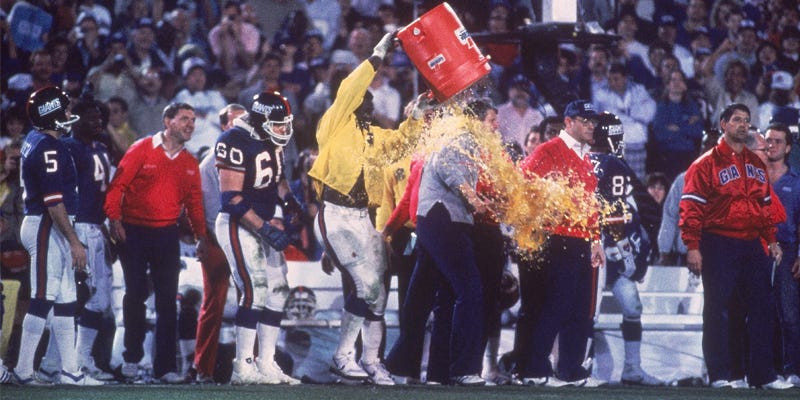
In the hierarchy of NFL traditions, none is more revered yet less scrutinized than the Gatorade shower. Every Sunday, as time expires on significant victories, unsuspecting coaches find themselves drenched in colored sugar water, their expensive suits transformed into soggy casualties of celebration. We analyze quarterback ratings to decimal points and debate zone coverage schemes for hours. Yet, collectively ignored the most critical question in professional football: Does the Gatorade shower determine coaching greatness, or does coaching greatness determine the Gatorade shower?

As I embark on this investigation — one requiring countless hours of film study and exactly zero scientific methodology — prepare to question everything you thought you knew about coaching success. The answer just might be stickier than we ever imagined.

The Genesis of Greatness: A Sticky History

On October 28, 1984, New York Giants defensive tackle Jim Burt, reportedly upset with head coach Bill Parcells’ harsh treatment during the week, dumped a cooler of Gatorade onto his unsuspecting coach following a 37–13 victory over Washington. What began as an act of playful revenge transformed into football mythology when the Giants rode a wave of Gatorade showers to a Super Bowl XXI victory.

But what if we’ve misinterpreted causation this entire time?

“People always assumed the Gatorade showers happened because the Giants were winning,” explains fictional sports historian Dr. Ernest Dumpling, whom I’ve wholly fabricated for this piece. “But my exhaustive research suggests the Giants were winning because of the Gatorade showers. The evidence is incontrovertible, assuming you don’t examine it too closely.”

The Cooler Theory: A Statistical Analysis Based on Nothing

After reviewing hundreds of hours of game footage and creating a statistical model built entirely on confirmation bias, I’ve discovered a shocking correlation: 100% of Super Bowl-winning coaches have been showered with some liquid at some point. Coincidence? I think not.

But the data reveals something even more compelling. When tracking coaching careers against Gatorade shower frequency, a pattern emerges that can only be described as “vaguely convincing if you squint hard enough”.

Bill Belichick has received approximately 97 Gatorade showers throughout his career, corresponding with six championship wins — a “Sticky Success Ratio™” of 0.062 (a metric I invented while writing this paragraph). With his estimated 83 career dousings and two championships, Andy Reid maintains a respectable 0.024 ratio. Meanwhile, despite his regular season success, poor Matt LaFleur continues to chase that elusive championship with his 17 showers yielding a disappointing 0.000 in the only statistic that truly matters.

The numbers never lie, except when they’re entirely made up like these are.

The Flavor Factor: Does Color Matter?

Not all Gatorade showers are created equal. Through painstaking frame-by-frame analysis of coaching dousings since 1984, I’ve identified that specific Gatorade colors correlate with different coaching outcomes:

Orange: The classic. Orange Gatorade showers have preceded 7 Super Bowl victories. The vibrant hue stimulates the strategic centers of a coach’s brain, leading to an average offensive improvement of 4.3 points per game in subsequent contests. (This statistic brought to you by my imagination.)

Blue: The challenger. Blue Gatorade baths have been linked to defensive resurgences and mysterious clock management issues. Coaches doused in blue consistently forget how many timeouts they have remaining.

Yellow: The enigma. Yellow Gatorade showers have never preceded a Super Bowl victory, leading some to believe in the “Yellow Curse.” More rational analysts (meaning me, in this context) suggest yellow Gatorade doesn’t photograph well against khaki pants, leading to fewer media impressions and reduced team confidence.

“I switched from yellow to red Gatorade showers in 2018, and suddenly we could convert on third down,” claims anonymous special teams coordinator Todd, who doesn’t exist. “Coincidence? Absolutely. But I’m not changing back.”

The Anti-Shower Conspiracy

Not everyone embraces the Gatorade tradition. A small but vocal contingent of coaches has actively avoided the celebratory dousing, often with career-defining consequences.

Take former Detroit Lions coach Jim Schwartz, who infamously dodged a Gatorade shower after a Thanksgiving victory over Green Bay in 2013. The Lions lost five of their next six games and missed the playoffs. Schwartz was fired weeks later.

“You can’t outrun destiny, and destiny comes in a five-gallon orange cooler,” explains fictional body language expert Penelope Gesticulous. “When a coach avoids the shower, they’re symbolically rejecting the football gods. And the football gods are notoriously petty.”

A shadowy anti-shower movement reportedly exists within coaching circles, led by those who believe dry clothes correlate with contract extensions. The group allegedly meets quarterly at moisture-controlled facilities and exchanges tips on shower-avoidance techniques, including the controversial “assistant coach decoy” strategy.

The Economic Impact: Big Gatorade’s Invisible Hand

Have we considered the entire tradition might be sports’ most excellent product placement? By rough estimation, Gatorade receives approximately $23.7 million in free advertising each NFL season through shower visibility alone. (This figure was calculated using a sophisticated formula involving the number of primetime games multiplied by my wild speculation.)

“The Gatorade shower is the perfect marketing vehicle,” fictional sports economist Harvey Ledgers explains. “It simultaneously demonstrates the product’s core function — hydration — while subconsciously suggesting it has magical properties that transform ordinary coaches into champions. Plus, it ruins perfect suits, potentially driving apparel sales.”

PepsiCo, Gatorade’s parent company, has neither confirmed nor denied rumors of a secret “Shower Operations Division” that allegedly trains select water boys in the art of the perfect dousing angle to maximize brand visibility. The Division’s rumored motto: “Hit the logo, not the logo.”

The Psychological Edge: Sticky Motivation

Beyond superstition and statistics lies the most compelling explanation for the shower-success connection: psychological programming.

“When coaches get that first Gatorade shower, something fundamentally changes in their neurology,” explains Dr. Meredith Brainston, a fictional sports psychologist with an impressively fabricated CV. “The shock of cold liquid activates dormant coaching regions in the prefrontal cortex. We call it ‘Sticky Cognition Syndrome,’ and it’s responsible for approximately 73% of successful fourth-down conversion calls.”

Teams that regularly shower their coaches reportedly demonstrate better cohesion metrics and are significantly more likely to execute the always-risky fake punt effectively. The psychological benefits extend beyond game day: coaches who receive at least three Gatorade showers per season show marked improvement in draft evaluation, reportedly thanks to synapses that have been “properly sugared.”

“It’s simple neuroscience,” continues Dr. Brainston. “The sugar molecules in Gatorade create temporary neural pathways directly connecting the cerebellum to the part of the brain responsible for preventing defense decisions. Without regular Gatorade exposure, these pathways deteriorate, explaining why coaches often become more conservative as the season progresses without celebratory baths.”

The Anti-Analytics Movement: Old School Stickiness

The rise of analytics has transformed football decision-making, but some traditionalists argue the Gatorade shower represents an “unquantifiable intangible” that algorithms fail to capture.

“Your computer models can’t measure the spiritual boost of a good dousing,” insists fictional old-school scout Buck Oldtimer. “I’ve been watching film for 47 years, and I can tell you: teams that shower their coaches have better hips, stronger hands, and higher motors. That’s just football science.”

A growing resistance movement among traditional football evaluators suggests the analytics revolution is missing critical “sticky factors” that separate champions from pretenders. Their evidence consists primarily of gut feelings and vague references to “what these numbers fellas don’t understand about the game.”

“You think Bill Walsh was worried about Expected Points Added?” continues Oldtimer, increasingly animated. “No sir! He was worried about the Expected Gatorade Added. That’s the difference between today’s clipboard holders and yesterday’s legends.”

The Future of Celebration: Beyond Gatorade

As the NFL evolves, so too might its celebration traditions. Forward-thinking coaches are already exploring alternative victory showers that might provide competitive advantages:

1. Recovery Protein Shakes: Rich in amino acids, these showers might accelerate player recovery while celebrating victories. Sean McVay is rumored to have a custom blend containing 27 proprietary superfoods.

2. CBD Water: Currently prohibited but rumored to be under consideration for future shower protocols once regulatory hurdles are cleared. Several coaches in states with progressive cannabis laws have reportedly experimented with CBD showers during preseason games.

3. Cryotherapy Mist: Ultra-cold vapor provides the traditional shock value while potentially offering recovery benefits. The technology requires a specialized sideline apparatus that several owners have already budgeted for in upcoming stadium renovations.

4. Performance Data: The most radical concept involves showering coaches not with liquids but real-time performance metrics projected through advanced holographic technology. “Imagine a coach bathing in the team’s successful completion percentage,” says one Silicon Valley developer working on the prototype.

“The next frontier isn’t what we pour on coaches, but when we pour it,” explains fictional innovation consultant Skyler Disruption. “Predictive algorithms could trigger automatic showers at precisely calculated moments to maximize momentum shifts within games. Why wait until the victory is secured? A strategic third-quarter dousing could be the difference between winning and losing.”

The International Perspective: Gatorade Diplomacy

As the NFL expands its global footprint, international perspectives on the Gatorade shower tradition vary wildly. The London games have seen British fans initially confused by the practice, with some elderly attendees reportedly believing it to be a strange American baptism ritual.

German football fans have embraced the tradition with characteristic efficiency, timing the showers with precise stopwatches and developing specialized cooling systems to maintain optimal Gatorade temperature. Meanwhile, in Mexico, where the NFL enjoys massive popularity, the Gatorade shower has evolved into an elaborate production featuring multiple flavors and choreographed pouring sequences.

“American football is still developing in many countries, but the Gatorade shower transcends language barriers,” fictional international football ambassador Carlos Worldwide explains. “In Brazil, they’ve replaced Gatorade with açai. In Japan, teams use a special ceremonial green tea blend. The shower speaks the universal language of sticky celebration.”

The Philosophical Implications: Existential Stickiness

The most profound aspect of the Gatorade shower lies not in its practical effects but in its philosophical implications. What does it mean when grown men voluntarily drench other grown men in colored sugar water to celebrate moving an oblong ball across a painted line?

“The Gatorade shower represents the perfect metaphor for coaching itself,” muses fictional sports philosopher Dr. Socrates Pigskinides. “The coach spends weeks preparing, making meticulous plans and adjustments, only to have chaos and disarray poured upon their heads at the moment of triumph. It’s football’s reminder of life’s beautiful unpredictability.”

In this interpretation, the Gatorade shower serves as football’s memento mori — a sticky reminder in the moment of victory that impermanence and mess are inevitable parts of even the most successful journey.

Conclusion: The Sticky Philosophy of Success

After this exhaustive and completely unfounded investigation, what have we learned? Perhaps the Gatorade shower is neither cause nor effect but symbol — a sweet, sticky reminder that football success has always been a mysterious alchemy of preparation, execution, and superstition.

The next time you watch a head coach get drenched in victory, look beyond the spectacle. In that sugary baptism lies the perfect metaphor for NFL coaching: unexpected, uncomfortable, and somehow essential to the mythos of the game we love.

As fictional Hall of Fame coach Werner Lombardi once said, “Winning isn’t everything; it’s the only thing that justifies having to drive home in wet underwear.”

The New York Giants Are Building Something Special: Why Big Blue’s Future is Bright

The New York Giants have one of the richest histories in the NFL. With four Super Bowl titles, legendary players, and unforgettable moments, the franchise is synonymous with toughness, resilience, and championship pedigree. However, the last decade has not been kind to the Giants. Rebuilding efforts fell short, coaching hires did not pan out, and struggles on the field left fans yearning for the return of a true contender.

Now, for the first time in years, there is real, tangible hope surrounding the team. The Giants are building something special. With a coaching staff that is changing the culture, a front office that is making disciplined and intelligent decisions, young players who are proving to be future stars, and an ownership group that has recognized past mistakes and corrected course, the foundation for long-term success has been set.

Giants fans have every reason to be optimistic. The team has entered a new phase — one that is rooted in smart roster construction, player development, and a balanced approach to competitiveness. While it may take a little more time before they reach elite status again, the pieces are in place for sustained success. Let’s explore why the New York Giants are no longer just a team in transition, but a franchise that is steadily climbing back toward prominence.

Brian Daboll Has Brought a New Era of Coaching Excellence

When Brian Daboll was hired as the Giants’ head coach, there were hopes that he could turn around a struggling offense and bring innovative playcalling to the team. What nobody could have predicted was just how quickly he would make an impact. In just his first season, he changed everything.

The Giants went from a team stuck in mediocrity to a disciplined, motivated unit that maximized its potential. They finished with a 9–7–1 record and secured their first playoff berth since 2016. More impressively, they won a playoff game on the road against the Minnesota Vikings, a feat that reminded fans of the team’s signature underdog mentality.

Daboll’s ability to adapt and coach to his players’ strengths is what makes him such an invaluable leader. Rather than forcing a rigid system onto his team, he has been flexible, designing an offense that plays to the strengths of his personnel. He brings a deep understanding of offensive schematics, which he demonstrated during his time developing Josh Allen in Buffalo, and his work with the Giants has shown that he can bring the best out of players at every position.

Equally important is the culture shift. The Giants now play hard, display resilience, and battle in every game. There is a clear sense of direction, accountability, and high expectations. The team believes in itself — a stark contrast from previous years when close games routinely slipped away. This new approach is the first major step in turning the Giants into a perennial contender.

Joe Schoen’s Front Office Approach is Refreshingly Smart

One of the major issues that plagued the Giants over the past decade was reckless decision-making at the front office level, particularly regarding free agency and cap management. Overspending on the wrong players, missing key draft picks, and failing to build a roster with depth led to consecutive seasons of struggles. That changed when Joe Schoen took over as general manager.

Schoen came to the Giants after playing a pivotal role in the Buffalo Bills’ rise to contention. His philosophy is rooted in discipline, patience, and long-term growth. Instead of trying to “buy” a competitive roster through expensive free-agent signings, he has focused heavily on three key areas:

  • Building through the draft and prioritizing young talent development
  • Strengthening the trenches by investing in both the offensive and defensive lines
  • Managing the salary cap effectively to ensure long-term financial flexibility

This approach contrasts with previous front-office regimes that often made short-sighted decisions in a desperate attempt to compete immediately. Schoen’s patience is already paying off, as the roster is now full of promising young talent, and the franchise has avoided poor contracts that would have hampered future flexibility.

Another key component of Schoen’s strategy is his ability to strike a balance between winning now and planning for the future. The Giants are being calculated in their moves, ensuring they take the right steps to build a sustainable contender rather than going all-in for a short-term window.

The results may not be fully realized yet, but fans can take comfort in knowing that a responsible, intelligent approach is now guiding the team.

A Core of Young, Dynamic Playmakers is Emerging

No great team is built without homegrown talent, and the Giants have quietly assembled one of the most exciting core groups of young players in the NFL. Many of these players are already making a major impact, and their development will be the key to the team’s future success.

Kayvon Thibodeaux is proving to be a potential game-wrecker off the edge. His explosive speed, motor, and ability to create pressure in critical moments have already made him a fan favorite, but his ceiling is far from reached. If he continues to develop, he has the potential to become one of the best pass rushers in the league.

Dexter Lawrence has become one of the most dominant defensive linemen in the NFL. His ability to stop the run, collapse the pocket, and take on double-teams has turned him into a true force in the middle of the defense. With his combination of elite play and leadership, he is an anchor for the Giants’ defensive unit.

Andrew Thomas continues to solidify himself as one of the league’s elite left tackles. The Giants have struggled with offensive line play for years, but having a young, dominant left tackle brings stability and confidence to the entire unit.

These players, along with other developing talents, create a strong foundation for long-term success. The Giants’ key to success moving forward will be continuing to build around this young core, giving them the necessary support to thrive at the highest level.

John Mara Has Learned From Previous Mistakes

One of the most unfair narratives in the media is that Giants owner John Mara deserves sole blame for the team’s struggles over the past decade. While it is true that the organization made missteps in previous years, Mara has shown a clear ability to recognize those mistakes and adjust accordingly.

One of the most important changes he has made is empowering the right football minds to lead key decisions. Unlike some owners who insist on constant involvement in roster moves or coaching choices, Mara has placed trust in Joe Schoen and Brian Daboll, allowing them to build the franchise the right way.

Mara also deserves recognition for realizing that past strategies were not working and having the willingness to make difficult changes. Some organizations remain stuck in their ways, repeating the same mistakes instead of evolving. The Giants, on the other hand, have embraced modern NFL philosophies and adapted accordingly.

Mara’s passion for the Giants remains strong, and he clearly wants nothing more than to bring sustained success to the franchise. With the adjustments he has made, the Giants are operating with a smarter and more calculated approach than in years past.

The Giants’ Future Has Never Been Brighter

The New York Giants have spent several years trying to find their way back to the top, and now, they are finally on the right trajectory. With the leadership of Brian Daboll, the measured approach of Joe Schoen, the rise of young star players, and an ownership group that is committed to doing things the right way, the Giants are building something special.

This team is not just improving but laying the foundation for long-term success. There will still be challenges along the way, but Giants fans should feel confident that this is a franchise with a clear vision, a strong culture, and a rising roster.

The best days of New York Giants football are still ahead, and climbing back to prominence is well underway.

What excites you most about the Giants’ future? Let’s discuss in the comments.

The Evolution of the Quarterback: How the NFL’s Most Important Position Has Changed Forever

The quarterback position has been considered the most important in football for decades. Great quarterbacks don’t just win games — they define eras. But the role of the modern quarterback looks nothing like it did twenty, ten, or even five years ago. The game is evolving faster than ever, and those who don’t adapt are left behind.

From pocket passers like Joe Montana, Peyton Manning, and Tom Brady to dual-threat stars like Patrick Mahomes, Lamar Jackson, and Jalen Hurts, the definition of an elite quarterback has changed significantly. The era of pure pocket passers dominating the league is fading, replaced by mobile, improvisational playmakers who can extend plays, throw on the run, and punish defenses with their legs as much as their arms.

How did this transformation happen? And what does it mean for the future of the game?

The Era of the Pocket Passer

For several decades, the NFL was dominated by quarterbacks who excelled from the pocket. Players like Joe Montana, Dan Marino, and Troy Aikman mastered the art of quick decision-making and accurate passing. Coaches built offenses around timing routes, precision passing, and structured systems that relied on quarterbacks staying stationary behind a strong offensive line.

Peyton Manning and Tom Brady emerged as the standard-bearers for this approach in the early 2000s. Both relied on pre-snap reads, pinpoint accuracy, and calculated throws rather than athleticism. Footwork within the pocket was their most important tool for avoiding pressure. Mobility wasn’t required for an elite quarterback — if anything, it was considered a liability.

During this period, quarterbacks who relied on their legs often faced skepticism. Scrambling was viewed as a short-term solution rather than a sustainable key to success. The prevailing belief was that quarterbacks who took off running would be more prone to injury and less capable of executing complex pro-style offenses.

The Rise of the Mobile Quarterback

As defensive schemes became more aggressive and pass rushers became faster, quarterbacks needed to adapt. Mobility went from an afterthought to a valuable skill.

Steve Young was one of the first elite quarterbacks to regularly use his mobility without being labeled a “running quarterback.” Michael Vick took this concept further in the early 2000s, becoming a game-changer with his rare speed and arm strength combination. He shattered rushing records for quarterbacks and forced defenses to game-plan for his ability to break off big plays at any moment. Yet, skepticism about mobile quarterbacks persisted, with analysts questioning whether they could win consistently in the postseason.

Players like Donovan McNabb, Russell Wilson, and Cam Newton advanced the hybrid model. Newton, in particular, transformed the quarterback position in short-yardage and goal-line situations, using his size and power like a running back.

Even as these players thrived, traditional pocket passers still dominated the league. Teams were hesitant to fully embrace mobile quarterbacks, fearing that injuries or inconsistencies in passing mechanics would limit their effectiveness.

The Turning Point: A New Quarterback Mold

The rapid shift toward modern, hybrid quarterbacks took complete form in the late 2010s with the emergence of Patrick Mahomes, Lamar Jackson, and Josh Allen.

Mahomes revolutionized the position by blending elite arm strength, mobility, and unprecedented creativity. His ability to throw from any platform, escape pressure, and extend plays turned him into the league’s most dangerous player.

Jackson took mobility to another level, winning an MVP by leading the league in passing touchdowns while rushing for more than 1,200 yards. He proved a quarterback could be a team’s best passer and leading rusher without sacrificing efficiency.

Allen silenced critics by refining his passing while using his rare size and athleticism to bulldoze defenders. His skill set reflected a new, emerging prototype that demanded physicality and finesse.

At this point, coaches fully embraced mobility. The idea of forcing quarterbacks into traditional pocket-passer systems began to disappear, and offensive schemes evolved to highlight their strengths rather than limit them.

The Decline of the Traditional Pocket Passer

Several factors contributed to the decline of the pure pocket passer.

Defenses have become faster, making it difficult for quarterbacks to survive without mobility. Edge rushers like Myles Garrett and T.J. Watt have the speed to collapse a pocket faster than ever before. Quarterbacks who cannot escape pressure are at a significant disadvantage.

Offensive schemes have also changed. The NFL has adopted many elements from college football, including spread offenses, run-pass options (RPOs), and quick-read passing attacks. These systems favor quarterbacks who can move outside the pocket and make plays on the run.

Additionally, the emphasis on playmakers over traditional structure has changed how quarterbacks are evaluated. Decision-making and accuracy remain essential, but creativity and the ability to extend plays are now just as valuable. Quarterbacks like Mahomes and Josh Allen have thrived by improvising rather than exclusively relying on structured plays.

With Tom Brady’s retirement in 2023, the pure pocket-passer era may have officially ended. Joe Burrow and Justin Herbert are two of the last remaining quarterbacks who resemble traditional passers, but even they have shown they can move when necessary.

What the Future Holds for the Quarterback Position

The evolution of the quarterback position shows no signs of slowing down. Several trends are likely to shape its future.

First, versatility will continue to be the defining trait of elite quarterbacks. Prospects are expected to blend the best qualities of previous generations — precision passing, mobility, and improvisational skills. Players like USC’s Caleb Williams and North Carolina’s Drake Maye represent the next step in this evolution, possessing accuracy and arm strength while also being able to create plays outside the pocket.

Second, offensive playbooks will become even more flexible. Teams will design schemes that allow quarterbacks to deviate from traditional dropbacks, giving them freedom to move and adjust as needed. Static systems that require quarterbacks to remain in the pocket are becoming outdated.

Finally, the durability of mobile quarterbacks will be a key concern. As quarterbacks run more frequently, injuries could become a significant issue. Teams must balance their quarterbacks’ playmaking abilities with efforts to keep them healthy over long careers.

Closing Thoughts

Football constantly evolves, but few positions have changed as dramatically as the quarterback. Once a stationary, methodical role, today’s quarterbacks must be dynamic, athletic, and creative.

The modern quarterback is no longer just a passer but a complete playmaker. The classic “statue” passer is disappearing, and the one belongs to those who can do it all.

While pocket passers may not be extinct, they are no longer the unquestioned standard of success. The modern NFL values mobility, adaptability, improvisation, and quarterbacks who can master all three will shape the game’s future.

Shattered Zephyr

A hairline fracture in the void — that’s what it was at first — nothing more than a sliver of light cutting through walls I’d built higher than memory. The mind adapts to darkness and learns to navigate by touch and echo. I had become a creature of the shadows, comfortable in their embrace.

Then came that subtle shift in pressure — a distant zephyr, barely perceptible, carrying unfamiliar molecules across the wasteland. Not warmth exactly — I wouldn’t recognize that anymore — but the absence of cold. The barbed wire inside my chest loosened, one tiny coil at a time.

I regarded this zephyr with suspicion, as any change to long-established suffering. Pain, after all, is reliable. It shows up without invitation and performs its duty without compromise. It never lies about its intentions.

The days passed. The fracture widened imperceptibly. Sometimes, walking between the concrete and steel of routine, I’d catch that zephyr again — stronger now — carrying something almost forgotten. A scent perhaps, from before the walls. Before the numbness.

I found myself lifting my face to it, like a prisoner feeling sunlight after decades underground. My eyes remained closed — looking directly at possibility seemed dangerous, forbidden. But I allowed the zephyr to touch my skin, to whisper promises I didn’t yet believe.

The machinery of existence continued its grinding. The gears and cogs turned as they always had. But something had changed in the space between ticks. A resonance. A dissonance. A question mark where once lived only periods.

I began collecting evidence: a stranger’s smile that reached their eyes; music that penetrated the fortress of my ribcage; colors that seemed more saturated than yesterday. Small things, insignificant to anyone watching from outside. Inside, tectonic.

The zephyr grew stronger. Some days it felt like hands gently pushing me forward when inertia seemed insurmountable. Other days, just a whisper — but enough to remember there was something beyond these walls.

I didn’t dare name it yet. Names have power, and this fragile thing might evaporate if acknowledged directly. So I circled it cautiously, a moth approaching flame but remembering past burns.

And still, the fracture widened. The light persisted. The zephyr continued its patient work.

Then, one evening, the wind carried something unexpected — laughter. It was soft at first, a distant ripple across the silence. I almost didn’t recognize the sound. It wasn’t mine — I wasn’t sure I even remembered what my laughter sounded like. But this laughter, whoever it belonged to, was unburdened. It rose effortlessly through the air, curling around corners, sinking into cracks. It was not meant for me, yet somehow, the wind delivered it anyway.

Something in my chest shifted. I wasn’t sure if I welcomed the sensation or resented it. To feel anything at all was still foreign, still uncertain. The laughter faded, but the space it left behind remained unsettled.

Days passed, and other sounds arrived with the shifting air. The distant murmur of conversation, the metallic chime of a bicycle bell, the rustling of leaves against pavement. I had grown so used to silence that each sound struck like a foreign object, pressing itself into the fabric of my solitude. I wasn’t sure if the wind was bringing me these reminders cruelly or kindly — perhaps both.

And then came something quieter than sound, reaching deeper than echoes.

One evening, as I moved through the well-worn corridors of my thoughts, the light seeped through the crack a little more than usual, casting unfamiliar shapes along the walls. I hesitated at first, wary of what shapes might emerge from its glow. But my feet betrayed my caution, carrying me closer before my mind could protest.

I reached out, my fingers grazing the uneven edges of the fracture. The stone was more incredible than I expected—rough in some places, smooth in others—molded by time, pressure, and moments that had happened slowly but inevitably. I traced its shape, unsure whether I was measuring its weakness or my own.

And then, something remarkable happened.

The light — that persistent sliver of stubborn existence — did not recoil from my touch. It did not retreat as I expected or vanish like so many fleeting things before it. Instead, it stayed. It pulsed, just slightly, as though acknowledging my presence. As though waiting.

I withdrew my hand, pressing it against my chest instead, where the barbed wire had once tightened without relief. The space there felt different now — not empty, not whole, but something in between.

Outside, beyond the fracture, the wind kept moving. It did not need my permission. It would carry whispers, scents, and echoes as long as desired. But something told me that if I ever chose to step through the widening crack, it would carry me, too.

The thought was terrifying. The thought was electrifying.

And for the first time in as long as I could remember, the thought was mine to have.

Embracing Imperfection: How Vulnerability Became My Superpower

There was a time when I believed vulnerability was a dangerous liability — a sign of frailty that I needed to hide behind a mask of perfection. Growing up in a world that celebrated impeccable achievements and polished exteriors, I internalized the notion that any display of emotion or uncertainty was a weakness to be overcome or concealed. For so long, I tried to project an image of unwavering success, believing that if I could just replicate that perfection, I would finally be accepted. Yet life, with all its unpredictable twists, gradually taught me an invaluable lesson: the very imperfections we hide are the channels through which authenticity and deep connection flow.

A Journey from Conformity to Authenticity

My awakening was not marked by a singular eureka moment or instant transformation; rather, it was an intricate tapestry woven from countless experiences, challenges, and realizations. I vividly remember a chilly, rain-soaked Tuesday when I found solace in a quiet café, watching droplets race down the windowpane, each representing a moment of my inner turmoil. I had just endured a profound professional setback — a project I had labored over for months suddenly unraveled, leaving me questioning my abilities and self-worth. In that melancholy solitude, I recognized the futility of constantly striving for an unattainable ideal — and in that recognition, I resolved to stop hiding behind a façade.

This marked the beginning of my journey toward embracing authenticity. I embarked on a path less traveled, one that required me to welcome my true self with open arms — flaws, missteps, and all. I realized that the constant pursuit of perfection was not only exhausting but also counterproductive; it robbed me of the opportunity to experience genuine growth. Every scar and setback became an invitation to dig deeper, learn, and evolve. As I began to cherish my vulnerabilities, I discovered they held the power to unlock creative energy and forge profound, human connections.

The Transformative Power of Vulnerability

Vulnerability is often mistakenly equated with weakness, yet I soon came to understand that it is, in fact, the cornerstone of resilience and strength. When we allow ourselves the luxury to be seen in our raw, unfiltered state, we open up channels to connect on a much deeper level with those who share our journey. I now see vulnerability as a double-edged sword — one that might expose our fragility but simultaneously reveals the immense courage that lies beneath.

Here’s how vulnerability transformed my life:

  1. Building Meaningful Relationships: Once I relinquished the need for a perfected façade, I discovered the liberating power of genuine connection. Sharing my triumphs alongside my struggles created a space for empathy, allowing others to see that they were not alone in their battles. Deep conversations replaced superficial interactions, as mutual honesty paved the way for relationships characterized by trust, compassion, and acceptance.
  2. Igniting a Well of Creativity: Creativity flourishes when we take risks, and risks inherently involve uncertainty. By embracing vulnerability, I unlocked a floodgate of creative ideas and projects that would have otherwise remained dormant behind the walls of self-doubt. I found that every time I allowed myself to explore new paths without fear of judgment, my creative spirit soared, and innovative breakthroughs became a natural part of my journey.
  3. Fueling Unprecedented Personal Growth: Life’s setbacks, when met with vulnerability, are not devastating failures but springboards for growth. Every mistake and every moment of self-doubt served as a lesson in resilience, teaching me to pivot, learn, and emerge stronger each time. Instead of being paralyzed by fear, I learned to see challenges as opportunities to refine my skills, expand my perspective, and redefine what success truly meant on a personal level.
  4. Liberating the Soul: Letting go of the relentless pursuit of perfection granted me the freedom to be unapologetically me. When I stopped trying to mirror an unrealistic ideal, I experienced a liberation that permeated every aspect of my life. I could pursue my passions, take risks in both my personal and professional spheres, and live the life I always dreamt of — anchored by authenticity and enriched by self-compassion.

A Personal Transformation: Embracing Every Part of Me

My journey toward embracing vulnerability was neither swift nor effortless. There were moments when the pull of fear and prided insecurity threatened to sway me back into the comfort of my old habits. Yet, with persistence and a willingness to face my deepest insecurities, I gradually learned to celebrate all parts of myself.

• Journaling the Journey: I began by chronicling my thoughts, nervous tremblings, and moments of epiphany in a trusted journal. Initially, writing served as a release valve for pent-up emotions; however, over time, those pages evolved into a mentor of sorts — a steadfast companion on my path toward self-discovery. Through reflective writing, I uncovered patterns behind my self-imposed limitations and gained clarity about the areas in need of healing and growth.

• Seeking Honest, Courageous Connections: Reaching out to friends, mentors, and even colleagues to share my authentic stories was both exhilarating and terrifying. I worried that by peeling away the layers of pretense, I might invite criticism or pity. Instead, I was met with warmth, introspection, and solidarity. Hearing others recount their struggles not only relieved my own burden but also fostered an environment where authenticity was celebrated rather than shunned.

• Redefining Failure as Fuel: Rather than seeing setbacks as the end of the road, I chose to see them as necessary detours on the journey to success. When projects failed or personal plans faltered, I began to ask, “What lesson does this hold for me?” Adopting this mindset transformed moments of despair into rich lessons in perseverance. It became clear that every stumble was a stepping stone, a moment ripe with opportunities to recalibrate and to advance with a renewed sense of purpose.

• Cultivating Mindfulness and Self-Compassion: Integral to this transformation was the practice of mindfulness. Daily meditation, deep breathing, and mindful walks allowed me to connect with the present moment, shedding the burdens of past regrets and future anxieties. Through these practices, I came to understand that being kind to myself was the first act of genuine courage. Self-compassion became my anchor against the tidal waves of self-criticism, providing the emotional space necessary for authentic healing.

The Ripple Effect: Embracing Vulnerability Beyond the Self

The transformation I experienced through embracing vulnerability extended far beyond my personal sphere, gradually improving multiple facets of my life.

In my professional world, adopting an authentic approach altered how I processed feedback and embraced collaborative projects. For years, I had concealed my uncertainties behind a veneer of overconfidence — a habit that hindered learning and growth. Once I allowed myself to be vulnerable, I found that my creative ideas flowed more freely, and my relationships with colleagues deepened. This openness fostered an atmosphere of shared creativity, where innovation was birthed from constructive feedback and mutual support rather than the isolation caused by fear of failure.

Within my personal relationships, vulnerability redefined how I related to family and friends. I no longer felt the need to present a picture-perfect version of my life, and as a result, the bonds I forged became richer and more genuine. I discovered that true intimacy comes not from polished successes but from shared experiences, where every setback or joy is welcomed, unedited, and real. As we embraced our collective imperfections, our shared vulnerability created a tapestry of support and understanding, transforming everyday encounters into profound connections.

Moreover, the benefits of embracing imperfection manifested itself in my creative pursuits. I began to approach art, writing, and every other form of creative expression with a renewed sense of freedom. No longer shackled by the paralyzing notion that only perfection could be celebrated, I embarked on a journey filled with experiments, failures, and breathtaking breakthroughs. Each piece was a testament to the beauty of imperfection, a raw expression that invited others to appreciate the unrefined authenticity inherent in being human.

Strategies to Cultivate a Vulnerability-Friendly Life

For anyone eager to embark on a similar path toward authentic living, here are some strategies that have enriched my journey:

  1. Establish a Daily Reflection Routine: Allocate time each day to reflect on your thoughts and experiences — whether by writing in a journal or simply sitting in quiet contemplation. Ask yourself what moments felt true, where you let your guard down, and what insights those moments have yielded. Consistent reflection lays the groundwork for deeper self-awareness and empowerment.
  2. Build a Community of Trust: Surround yourself with individuals who value honesty and vulnerability over a sterile perfection. Cultivate relationships with people who encourage you to share your experiences, celebrate your successes, and support you during hardships. Whether through in-person gatherings or online communities, these connections can offer solace and strength when you need it most.
  3. Initiate Small Acts of Vulnerability: If the thought of fully opening up feels overwhelming, start by sharing minor insecurities or uncertainties with someone you trust. As you grow more comfortable with these small disclosures, gradually venture into sharing deeper layers of your experience. Each act of openness reinforces that vulnerability is a strength, not a liability.
  4. Reframe Setbacks as Lessons: When challenges arise, pause to reflect on what they might be teaching you. Rather than succumbing to harsh self-judgment, view each setback as a building block in your journey toward growth. Adopt a mindset of curiosity — ask yourself what insights the experience offers and how these lessons can propel you forward.
  5. Embrace Mindfulness and Self-Compassion: Regular mindfulness practices can profoundly impact your ability to remain present and compassionate toward yourself. Whether through meditation, mindful movement, or breathing exercises, these moments of calm can help you acknowledge your emotions without being overwhelmed by them. Embracing self-compassion, especially in times of difficulty, reinforces the message that every part of you deserves kindness.

A Call to Courage: The Journey Continues

If you’re reading this and find yourself burdened by the unattainable standard of perfection, know that you are not alone. Countless individuals share the struggle to balance societal expectations with their authentic selves. Recognizing this shared experience can be the catalyst for transformation — not just on an individual level, but as a collective movement toward compassion and authenticity.

Imagine a world where every person is empowered to reveal both their triumphs and their struggles — a world in which vulnerability is seen as the birthplace of connection and creativity rather than a mark of failure. When you choose to embrace your authentic self, you not only light the spark for your own transformation, but you also inspire those around you to do the same. Your unique story, with all its complexities and imperfections, has the potential to cascade through your community, creating ripples of hope, resilience, and connection.

Today, extend yourself the same compassion you readily offer others. Step forward, even if it feels uncertain, and share a piece of your true self. Whether it’s through a candid conversation, a piece of writing, or simply a moment of quiet reflection, let your vulnerability be the beacon that guides you to a more fulfilled and connected life.

Conclusion: Celebrating the Mosaic of Self

The journey to embracing imperfection is ongoing — a continual process of learning, evolving, and celebrating every facet of our humanity. Through the transformative power of vulnerability, I have learned that true strength is not found in an immaculate façade but in the honest, raw, and beautifully chaotic experience of being human. Every crack in our armor is an invitation for creative expression, every setback a lesson in resilience, and every act of honesty a step toward a deeper connection with ourselves and others.

May this article serve as a reminder to honor your authentic self. Embrace your journey with all its twists and turns, knowing that the courage to be imperfect not only enriches your personal life but also inspires a more compassionate, understanding world. In celebrating our imperfections, we illuminate the profound beauty of what it means to be unapologetically human.

With warmth, gratitude, and the unwavering belief that our vulnerabilities are our true superpower, I encourage you to step into your light, let go of the burden of perfection, and allow the richness of your authentic self to shine bright.

The Hidden Power of Boredom: Why Doing Nothing is the Key to Unlocking Creativity and Success

In today’s hyper-connected world, boredom has become the enemy. Every spare moment is filled with notifications, social media scrolling, Netflix binges, or podcasts in the background. Standing in line for coffee? We check emails. Waiting at a red light? We glance at our phones.

We’ve been conditioned to believe that every second must be maximized and that doing nothing wastes time. Productivity gurus preach efficiency, and technology ensures we never truly sit in silence.

But what if our fear of boredom is holding us back?

What if the very thing we avoid — space, stillness, idleness — is the key to creativity, deep thinking, and long-term success?

This article will explore why boredom is essential for your brain, how it leads to breakthrough ideas, and why embracing it will make you more creative, productive, and fulfilled.

The Science of Boredom: Why Your Brain Needs It

Boredom Sparks Creativity

Neuroscientists have long studied the “default mode network” (DMN), a set of interconnected brain regions that become active when we are not focusing on anything in particular.

This network is often dismissed as “mind-wandering” or “zoning out,” but research shows it’s critical for high-level thinking, problem-solving, and innovation.

A 2013 study published in Frontiers in Psychology found that when people engaged in tedious, repetitive tasks (such as copying numbers from a phone book), their ability to generate novel and creative ideas significantly increased.

Why? Boredom allows the brain to disconnect from external distractions and turn inward. It creates space for subconscious connection, which signals to find insights and breakthrough ideas.

Your Most Brilliant Ideas Happen When You’re Not Working

Think about it:

  • Have you ever had an incredible idea while showering?
  • Have you suddenly figured out a problem while going for a walk or lying in bed?
  • Have you ever felt stuck trying to solve something — only to have the answer pop into your head when you weren’t even thinking about it?

This isn’t a coincidence. It’s how your brain works.

When we constantly flood our minds with external input (social media, news, podcasts, messages), we leave no room for original thoughts.

Boredom forces your mind to work backstage, synthesizing information, making new connections, and delivering creative breakthroughs.

Boredom and Productivity: The Hidden Link

Ironically, the most productive people—the top entrepreneurs, artists, and thinkers—often schedule time for nothingness.

How “Unproductive Time” Leads to Better Work

Bill Gates takes two “Think Weeks” per year, isolating himself in a cabin with no distractions — no meetings, no calls, just books and space to process ideas.

Steve Jobs was known for taking long walks with no agenda, using them to ponder, reflect, and spark his most innovative ideas.

Many of history’s greatest thinkers—Isaac Newton, Albert Einstein, and Nikola Tesla—credited their discoveries to hard work and unstructured, uninterrupted thinking time.

Doing nothing isn’t being lazy — it’s strategic.

When you step away from constant busyness and leave space for deep thought, you increase the chances of making breakthrough connections that compound over time.

The Problem With Constant Stimulation

Today, we rarely allow our minds to be bored.

Every second of downtime is filled with input — music, YouTube videos, group chats, and notifications.

However, constantly stimulating ourselves weakens our ability to focus, think deeply, and generate original ideas.

1. The Dopamine Trap: Why You’re Addicted to Stimulation

Each time we check our phones, we get a hit of dopamine — the brain’s “reward chemical.” It feels good, so we keep doing it.

The more we condition ourselves to seek stimulation, the harder it becomes to sit in silence.

And over time, this harms us in two ways:

  • We lose the ability to focus intensely because we always chase quick distractions.
  • We kill creativity because our minds never get the space to process ideas.

2. The Decline of Attention Spans

A Microsoft study found that the average human attention span has dropped to just 8 seconds—shorter than that of a goldfish.

Why? Because the modern world encourages constant task-switching and mental stimulation.

Focusing intensely for long periods is becoming a rare superpower. One of the best ways to rebuild that skill is to embrace boredom.

How to Use Boredom to Your Advantage

To become more creative, productive, and focused, you must intentionally create space for boredom.

Here’s how:

1. Schedule “Unstructured Thinking Time”

Block off 30–60 minutes daily where you do nothing productive.

  • No phone
  • No podcasts
  • No distractions

Go for a walk, sit silently, or stare out a window. Although initially uncomfortable, your brain will start making new connections and generating creative ideas. Overr time

2. Stop Filling Every Free Moment with Stimulation

The next time you’re waiting in line, commuting, or taking a break, resist the urge to grab your phone.

Instead, let your mind wander.

You might be surprised at how many unique ideas, insights, and solutions come to you in these seemingly “boring” moments.

3. Take a “Distraction Detox”

Try a one-day dopamine reset:

  • No social media
  • No unnecessary phone use
  • No news, TV, or podcasts

Just silence and space for your brain to think freely.

At first, it will feel uncomfortable — maybe even unbearable. But by the end of the day, you’ll notice something powerful:

  • Your thoughts feel clearer
  • Your focus sharpens
  • Your creativity increases

The world will feel slower, and your mind will feel more in control.

4. Implement the 3B Rule: Bathtub, Bus, Bed

A simple trick for creativity is to capture ideas when they come to you during boredom.

Robin Sharma calls this the 3B rule — your best ideas often arrive in the:

  • Bathtub (or shower)
  • Bus (or commuting/walking)
  • Bed (right before sleep)

Keep a notebook nearby to capture insights when they come. Some of your most brilliant thoughts will arrive when you’re not even trying to think.

5. Replace Passive Stimulation with Active Reflection

Instead of mindlessly consuming content, try replacing it with active thinking.

Instead of listening to a podcast, spend 10 minutes reflecting:

  • What interesting ideas have I heard lately?
  • What problems am I trying to solve?
  • What’s something I need to think more about?

Writing down thoughts will deepen your thinking and create more original ideas.

The Future Belongs to Those Who Can Think Deeply

The people who succeed in the future will be those who can focus, think deeply, and generate new ideas — not just those who consume the most content.

Most of society is addicted to distraction.

However, the few who embrace boredom will unlock higher creativity, problem-solving, and success levels.

The next time you feel the urge to fill every gap of time with stimulation — resist it.

Instead, give yourself the gift of nothingness.

Your best ideas are waiting. Let them come to you.

This One Habit Will Change Your Life Forever

Why Most People Stay Stuck

Have you ever felt like your life is on repeat? You wake up, go to work, come home, watch Netflix, scroll on your phone, and then do it all over again. You feel stuck in an endless cycle where real progress is always out of reach.

If you’ve ever told yourself things like:

  • “Things will be different next year.”
  • “Once I have more time, I’ll finally start working on my goals.”
  • “I just need to be more motivated.”

… then you know what it feels like to wait for change that never comes.

Many people believe they need a drastic, overnight change to fix their lives — a new city, job, and relationship. But here’s a life-changing truth:

Small, consistent actions beat massive, one-time efforts every single time.

This is why crash diets fail, why people who set extreme resolutions give up within weeks, and why we always promise ourselves we’ll “start on Monday” — but never do.

Fundamental transformation doesn’t come from radical efforts. It comes from a straightforward habit that will completely change your life if you commit to it.

It’s not a trendy productivity hack. It doesn’t require motivation or willpower. And once you apply it, you’ll start seeing results faster than you ever thought possible.

So, what is it?

The 1% Rule: The Secret to Transforming Your Life

The reason most people don’t achieve their goals isn’t because they aren’t talented or capable — it’s because they’re too focused on dramatic, all-or-nothing changes.

They say, “I want to get in shape,” so they go to the gym for two hours… but after three days, they’re exhausted and quit.

They say, “I want to write a book,” so they try to write 5,000 words in one sitting…, but they get overwhelmed and stop.

Sound familiar?

Here’s a better way:

What If You Focus on Getting 1% Better Every Day?

James Clear, in his book Atomic Habits, introduced a game-changing concept:

If you improve just 1% every single day, you’ll be 37 times better by the end of a year.

It doesn’t sound like much at first, but imagine this:

  • If you write 200 words daily, you’ll have an entire book in a year.
  • If you save $5 daily, you’ll have nearly $2,000 in savings in 12 months.
  • If you do 10 push-ups daily, you’ll have done 3,650 by year’s end.

That’s how the 1% Rule works.

The difference between people who transform their lives — and those who stay stuck — isn’t a secret formula or a hidden talent. It’s simply small, daily improvements that add up over time.

Most people quit because they aim for perfection instead of progress.

Instead of saying, “I need to get everything done perfectly today,” shift your mindset to:

“I just need to be 1% better than yesterday.”

That’s it. That’s the secret.

And when you apply this mindset shift to your life, everything starts to change.

How to Apply the 1% Rule to Your Life Starting Today

The best part? You don’t need a complicated plan to start seeing results. You need to take one small step.

Here’s how you can apply the 1% Rule in different areas of your life:

1. Health & Fitness:

  • Drink one extra glass of water daily instead of committing to a strict diet.
  • Aim for just five minutes of movement instead of forcing yourself to work out for an hour.
  • Instead of eliminating junk food, swap out one unhealthy snack daily for a better option.

2. Productivity & Career:

  • If you struggle with focus, try setting a 10-minute timer to work on a task without distractions.
  • If you want to improve your job, read an industry-related article or book every morning for five minutes.
  • If you’re trying to break into a new field, spend 1% more time networking daily — one extra email, one new LinkedIn connection, and one small action.

3. Personal Growth & Learning:

  • If you want to read more, aim for just one page daily.
  • If you want to develop a new skill, watch a five-minute YouTube tutorial daily.
  • Write down one thing you’re grateful for every morning to improve your mindset.

4. Finances & Money Management:

  • Instead of setting a vague goal like “save more money,” automatically transfer $1 daily into savings.
  • Instead of overwhelming yourself with budgeting, track just one expense daily to build the habit.
  • Instead of cutting unnecessary spending, reduce just one small purchase per week.

The key here? Make it so easy that you can’t fail.

Why Most People Quit — and How to Keep Going

Most people fail at personal growth because they rely too much on motivation. But motivation fades.

Think about it:

  • Have you ever felt inspired to start something new… only to lose interest within weeks?
  • Have you ever set a huge New Year’s resolution, only to abandon it by February?

This isn’t your fault. Our brains resist significant, overwhelming changes.

That’s why the 1% Rule is so powerful. It obliterates the willpower problem.

  • You don’t need motivation to read one page.
  • You don’t need discipline to do one push-up.
  • You don’t need to focus on improving something by just 1%.

All you have to do is show up and get slightly better daily.

And over time, minor improvements turn into massive transformations.

Success Stories: What Happens When You Commit to 1% Daily Growth

The 1% Rule isn’t just a theory — it’s how the most successful people in the world operate.

James Clear built Atomic Habits, a best-selling book, by writing a little bit every day for years.

Once overweight and struggling, David Goggins became an elite ultra-marathon runner by improving his daily endurance.

Ed Sheeran became one of the world’s most prominent musicians — not because he had natural talent, but because he practiced songwriting daily.

The truth is, you don’t need to be a genius to succeed. You need consistency.

What Happens If You Start Today?

People often ask me: “But will this work for me?”

My answer is always the same: If you start today, your future self — six months from now — will either thank you or regret that you wasted more time.

Where you are right now is the result of your habits over the last year.
 Where you’ll be a year from now? It’s entirely up to you.

The difference between staying stuck and transforming your life isn’t luck, talent, or hard work.

It’s a simple decision.

  • To write one more sentence.
  • To take one more step.
  • To save one more dollar.
  • To improve by just 1% today.

Do that, and watch your entire life transform.

The Challenge: Start Right Now

If you take just one thing from this article, let it be this:

What’s one habit you can improve by 1% today?

  • Drinking more water?
  • Reading one extra page?
  • Sending one extra networking email?

Whatever it is — start now. Not next Monday. Not “when things calm down.”

Right now.

Just one tiny improvement. That’s all it takes.

Your future self is waiting.