
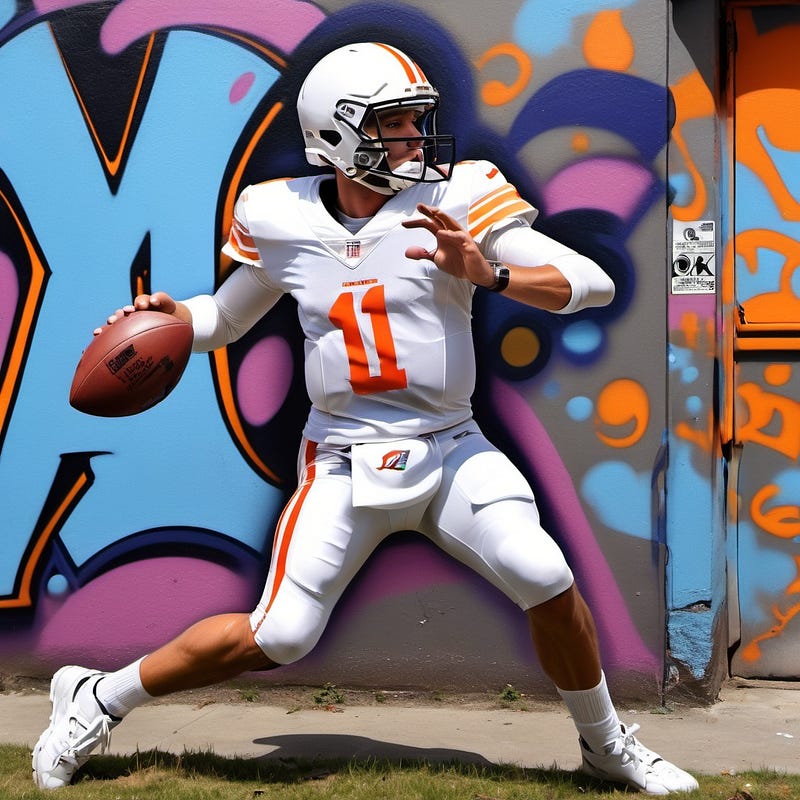
The quarterback position has been considered the most important in football for decades. Great quarterbacks don’t just win games — they define eras. But the role of the modern quarterback looks nothing like it did twenty, ten, or even five years ago. The game is evolving faster than ever, and those who don’t adapt are left behind.
From pocket passers like Joe Montana, Peyton Manning, and Tom Brady to dual-threat stars like Patrick Mahomes, Lamar Jackson, and Jalen Hurts, the definition of an elite quarterback has changed significantly. The era of pure pocket passers dominating the league is fading, replaced by mobile, improvisational playmakers who can extend plays, throw on the run, and punish defenses with their legs as much as their arms.
How did this transformation happen? And what does it mean for the future of the game?
The Era of the Pocket Passer
For several decades, the NFL was dominated by quarterbacks who excelled from the pocket. Players like Joe Montana, Dan Marino, and Troy Aikman mastered the art of quick decision-making and accurate passing. Coaches built offenses around timing routes, precision passing, and structured systems that relied on quarterbacks staying stationary behind a strong offensive line.
Peyton Manning and Tom Brady emerged as the standard-bearers for this approach in the early 2000s. Both relied on pre-snap reads, pinpoint accuracy, and calculated throws rather than athleticism. Footwork within the pocket was their most important tool for avoiding pressure. Mobility wasn’t required for an elite quarterback — if anything, it was considered a liability.
During this period, quarterbacks who relied on their legs often faced skepticism. Scrambling was viewed as a short-term solution rather than a sustainable key to success. The prevailing belief was that quarterbacks who took off running would be more prone to injury and less capable of executing complex pro-style offenses.
The Rise of the Mobile Quarterback
As defensive schemes became more aggressive and pass rushers became faster, quarterbacks needed to adapt. Mobility went from an afterthought to a valuable skill.
Steve Young was one of the first elite quarterbacks to regularly use his mobility without being labeled a “running quarterback.” Michael Vick took this concept further in the early 2000s, becoming a game-changer with his rare speed and arm strength combination. He shattered rushing records for quarterbacks and forced defenses to game-plan for his ability to break off big plays at any moment. Yet, skepticism about mobile quarterbacks persisted, with analysts questioning whether they could win consistently in the postseason.
Players like Donovan McNabb, Russell Wilson, and Cam Newton advanced the hybrid model. Newton, in particular, transformed the quarterback position in short-yardage and goal-line situations, using his size and power like a running back.
Even as these players thrived, traditional pocket passers still dominated the league. Teams were hesitant to fully embrace mobile quarterbacks, fearing that injuries or inconsistencies in passing mechanics would limit their effectiveness.
The Turning Point: A New Quarterback Mold
The rapid shift toward modern, hybrid quarterbacks took complete form in the late 2010s with the emergence of Patrick Mahomes, Lamar Jackson, and Josh Allen.
Mahomes revolutionized the position by blending elite arm strength, mobility, and unprecedented creativity. His ability to throw from any platform, escape pressure, and extend plays turned him into the league’s most dangerous player.
Jackson took mobility to another level, winning an MVP by leading the league in passing touchdowns while rushing for more than 1,200 yards. He proved a quarterback could be a team’s best passer and leading rusher without sacrificing efficiency.
Allen silenced critics by refining his passing while using his rare size and athleticism to bulldoze defenders. His skill set reflected a new, emerging prototype that demanded physicality and finesse.
At this point, coaches fully embraced mobility. The idea of forcing quarterbacks into traditional pocket-passer systems began to disappear, and offensive schemes evolved to highlight their strengths rather than limit them.
The Decline of the Traditional Pocket Passer
Several factors contributed to the decline of the pure pocket passer.
Defenses have become faster, making it difficult for quarterbacks to survive without mobility. Edge rushers like Myles Garrett and T.J. Watt have the speed to collapse a pocket faster than ever before. Quarterbacks who cannot escape pressure are at a significant disadvantage.
Offensive schemes have also changed. The NFL has adopted many elements from college football, including spread offenses, run-pass options (RPOs), and quick-read passing attacks. These systems favor quarterbacks who can move outside the pocket and make plays on the run.
Additionally, the emphasis on playmakers over traditional structure has changed how quarterbacks are evaluated. Decision-making and accuracy remain essential, but creativity and the ability to extend plays are now just as valuable. Quarterbacks like Mahomes and Josh Allen have thrived by improvising rather than exclusively relying on structured plays.
With Tom Brady’s retirement in 2023, the pure pocket-passer era may have officially ended. Joe Burrow and Justin Herbert are two of the last remaining quarterbacks who resemble traditional passers, but even they have shown they can move when necessary.
What the Future Holds for the Quarterback Position
The evolution of the quarterback position shows no signs of slowing down. Several trends are likely to shape its future.
First, versatility will continue to be the defining trait of elite quarterbacks. Prospects are expected to blend the best qualities of previous generations — precision passing, mobility, and improvisational skills. Players like USC’s Caleb Williams and North Carolina’s Drake Maye represent the next step in this evolution, possessing accuracy and arm strength while also being able to create plays outside the pocket.
Second, offensive playbooks will become even more flexible. Teams will design schemes that allow quarterbacks to deviate from traditional dropbacks, giving them freedom to move and adjust as needed. Static systems that require quarterbacks to remain in the pocket are becoming outdated.
Finally, the durability of mobile quarterbacks will be a key concern. As quarterbacks run more frequently, injuries could become a significant issue. Teams must balance their quarterbacks’ playmaking abilities with efforts to keep them healthy over long careers.
Closing Thoughts
Football constantly evolves, but few positions have changed as dramatically as the quarterback. Once a stationary, methodical role, today’s quarterbacks must be dynamic, athletic, and creative.
The modern quarterback is no longer just a passer but a complete playmaker. The classic “statue” passer is disappearing, and the one belongs to those who can do it all.
While pocket passers may not be extinct, they are no longer the unquestioned standard of success. The modern NFL values mobility, adaptability, improvisation, and quarterbacks who can master all three will shape the game’s future.
 Blair Steward