
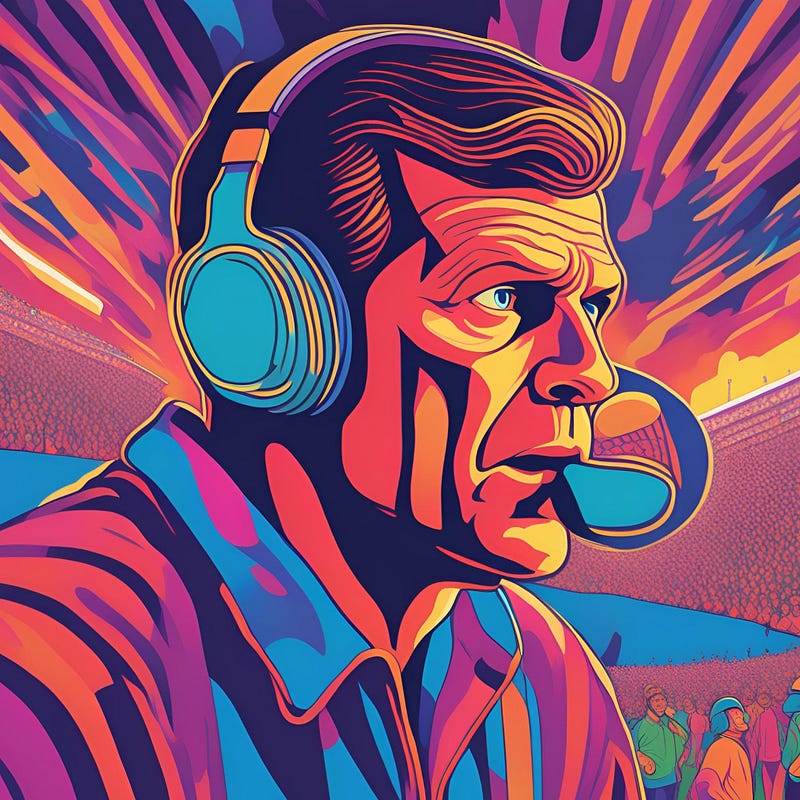
In the age of encrypted headsets and high-definition broadcasts, one of football’s oldest sideline habits persists. What are they hiding?
By Blair Steward
Anyone who has watched the NFL has seen the now-familiar gesture. A coach clamps a laminated play sheet to his mouth, leans into his headset, and relays vital information. Defensive coordinators do it. Quarterbacks do it. Head coaches do it so often that it has become a feature of the game’s visual language.
This gesture resembles something secretive—like a code relayed during a war room operation. To the casual viewer, it seems like common sense. Yet when examined closely, a question arises that most people never voice: Why is this still necessary?
The NFL uses encrypted coach-to-player headsets. Signals are secure. Teams do not have access to each other’s communications. In an era when technology governs nearly all aspects of the game, what function does hiding one’s mouth serve?
The answer is equal parts strategic, psychological, and cultural. It reveals more about how the modern NFL operates than one might expect.
The Origin: Lip Reading in the HD Era
The most common explanation for this behavior involves lip reading. That defense is not unfounded. During the 2000s, as television broadcasts transitioned to high-definition, everything changed. Previously, grainy images gave way to crisp facial detail. Broadcast crews began capturing sideline reactions during breaks in play. Once immune to visual scrutiny, coaches became visible to millions of viewers — and potentially to opponents.
Teams did not take long to use these broadcasts as scouting assets. Staffers began analyzing opposing coaches’ verbal cues. Some even assigned interns to review footage frame by frame, searching for repetitive mouth movements that could be linked to play calls. What began as curiosity began to resemble espionage.
To combat this new threat, coaches began shielding their mouths. The logic was sound. If facial movements could be tied to known plays or situational cues such as audible checks or blitz calls, then total visual discretion was necessary. A habit was born. Over time, it became a ritual.
Encrypted Communication Changed the Game — But Not the Habit
Eventually, the NFL responded to growing concerns by implementing enhanced communication protocols. Coach-to-player audio transmissions are now encrypted, limited to designated personnel, and monitored by the league. Quarterbacks and defensive captains receive transmissions through helmet speakers that cut off with fifteen seconds remaining on the play clock. These measures prevent cross-channel interference and ensure information security.
Given these protections, shielding one’s mouth might seem obsolete. If no one can intercept the audio, what is truly being protected?
The answer lies in the fact that not all communication happens via headset. Coaches still rely on face-to-face instruction with players—position coaches relay tactics between downs. Defensive coordinators shout to on-field personnel during pre-snap adjustments. In many of these cases, mouth movement is visible.
In such moments, a play sheet or clipboard becomes a low-tech but effective encryption method. Even if no opponent is actively lip-reading, the risk of habitually revealing something remains. For coaches, it only takes one mistake to cost a game — or a job.
The Spygate Legacy and Culture of Suspicion
No conversation about sideline secrecy would be complete without addressing the Spygate scandal. In 2007, the New England Patriots were penalized for videotaping the New York Jets’ sideline during games to decode defensive signals. Although the central issue involved signal stealing, not audio or lip-reading, the scandal permanently shifted the league’s culture.
Coaches became hyper-aware of information exposure. The idea that one team might be trying to steal another’s signals no longer felt theoretical — it became institutional memory. From then on, every possibility, no matter how unlikely, had to be guarded against. Precaution turned into a professional imperative.
The practice of mouth covering became not just defensible but necessary. A laminated play card upset no one, but a security breach, even unintended, could end a season.
Paranoia, in football as in espionage, often prevails over probability.
Not Every Sideline Conversation Is Private
As mentioned earlier, not all game-time communication goes through the headset. A significant portion of coaching still happens the old-fashioned way: in-person, face-to-face, often during moments of urgency or ehaos.
For example, defensive coordinators frequently use hand or mouth signals during hurry-up situations when time is short and substitutions are in flux. Coaches cannot always rely on the radio relay, particularly for non-captain players. These sideline moments are visible to fans, cameras, and opponents.
Theoretically, if a camera can see a coach’s lips move, anyone could capture and analyze that footage. While the average opposing coach may not be scouring tape for lip movements, larger staffs, digital equipment, or even independent analysts could use specialized techniques to monitor speech recognition on game film.
Against that backdrop, shielding one’s mouth is not excessive. It is common sense.
Broadcast Cameras Raise the Stakes
In the modern NFL, games are productions. Every major broadcast features many cameras, many in motion, recording from multiple angles—the sky, the end zone, and the sideline. These feeds don’t just reach television audiences. They exist in public record and are available to anyone willing to invest the time, equipment, and ethics to review them.
Close-up shots of coaches before and after plays are now part of every broadcast. The reasoning is straightforward: television wants emotion, intimacy, and storyline-building. However, this also means the speech of any frustrated coach or captured communication can be read, analyzed, or taken out of context.
Even perceived emotion can become a spectacle. A coach muttering under his breath without covering his mouth might inspire a viral clip, a Twitter controversy, or shaky amateur interpretations. If a coach’s words appear to criticize a player or second-guess a decision, it becomes “headline material” — regardless of accuracy.
In that light, mouth-covering becomes reputation management. It protects not just tactics, but a coach’s public image.
Ritual, Routine, and Human Psychology
Beyond the strategic rationale lies a more straightforward, human truth: people cling to routine. Many coaches began shielding their mouths years ago. They won a key game while doing it, and their teams improved. Eventually, it became part of their mental preparation.
Top-level athletes and coaches rely on rhythm and superstition, not just reason. They rehearse game-day behaviors not to appear logical but to feel emotionally in control. Covering one’s mouth becomes a subtle psychological anchor—a gesture that confirms focus and quiets the noise surrounding high-stakes decision-making.
Take that gesture away, and the coach may feel unexpectedly exposed.
Even among those who understand the encryption mechanics and dismiss surveillance concerns, the act serves an internal purpose. It acts like a shield on a racehorse— a brief shield from sensory overload.
A Deliberate Act of Control in a Chaotic Game
Consider that football is a game with rapidly moving parts, limited time, and enormous pressure. Every decision is both tactical and emotional. The margin for error is vanishingly tiny. A sour call can mean between advancing to the playoffs and missing the postseason.
In that environment, rituals gain importance. Devices like play sheets or clipboards become more than tools — they become buffers against distraction. When a coach covers his mouth during a play call, he engages in a highly deliberate, physical act of narrowing his focus. It signals seriousness. It marks the moment as important.
Whether it deters espionage or not, it reminds the speaker—and everyone watching—that the stakes are significant.
Who Are They Hiding From?
Here lies the paradox. The gesture may have begun as a countermeasure against actual lip-reading. It may have evolved as a reaction to scandals like Spygate. Yet today, the gesture is not just about throwing a defense off balance. It shields a coach not from rivals across the field, but from fans, media, and even self-doubt.
NFL broadcasts are no longer games. They are spectacles. A coach’s face may be in close-up more often than a quarterback’s. In that world, every angle is a camera angle. Every sigh is dissected.
So, when a coach covers his mouth during a routine series, he’s not just keeping the defense honest. He is protecting the one thing he must preserve in that moment: clarity.
Final Thought
The most minor habits often speak volumes in a game governed by inches, decisions, and details. Coaches cover their mouths not because it is always necessary, but because, in their world, even unnecessary precautions are required.
The practice may feel outdated. It may no longer prevent most tactical data from leaking. Yet, it creates a moment of control—a rare shield against known enemies and unknown vulnerabilities. In professional football, every edge matters, even an imagined one.
The next time you watch an NFL game and see a coach raise a play sheet to his lips, know that the gesture you are witnessing is not just strategic. It is psychological. It is historical. It is human.
In a sport where so much happens behind the scenes, the most important call of the game may be the one you never hear — and never see.
 Blair Steward